For ADHD brains, and anyone who switches a lot
Focus that actually feels good.
Dopamingo turns task-switching into structure: short focus blocks on what matters, tiny healthy breaks in between, and a kind look back at everything you did. No streaks to break. No guilt.
14-day free trial · no card, no account · Mac and Windows
- 🔬 Built on 26+ studies
- 🔒 Private: no account, works offline
- 🦩 One payment, yours to keep

Sound familiar?
It's not a willpower problem.
Your brain isn't broken. Most productivity tools are built for brains that run on schedules and streaks. Yours runs on interest, urgency and novelty.
You sit down to work and somehow it's 3pm.
Time slips by unnoticed, then suddenly it's all gone.
A thought pops up mid-task…
…and twenty minutes later you're somewhere else entirely.
Every planner works for four days.
Then one rough day ends the streak, and it's hard to go back.
Starting is the hardest part.
The task isn't hard. Getting going is.
The idea
Rotate, don't grind.
You're going to switch anyway. So Dopamingo makes switching the plan: a focus block, a tiny healthy break, then the next block. Your brain gets the novelty it wants, and your work still moves forward.
How it works
Three steps. About two clicks.
- 1
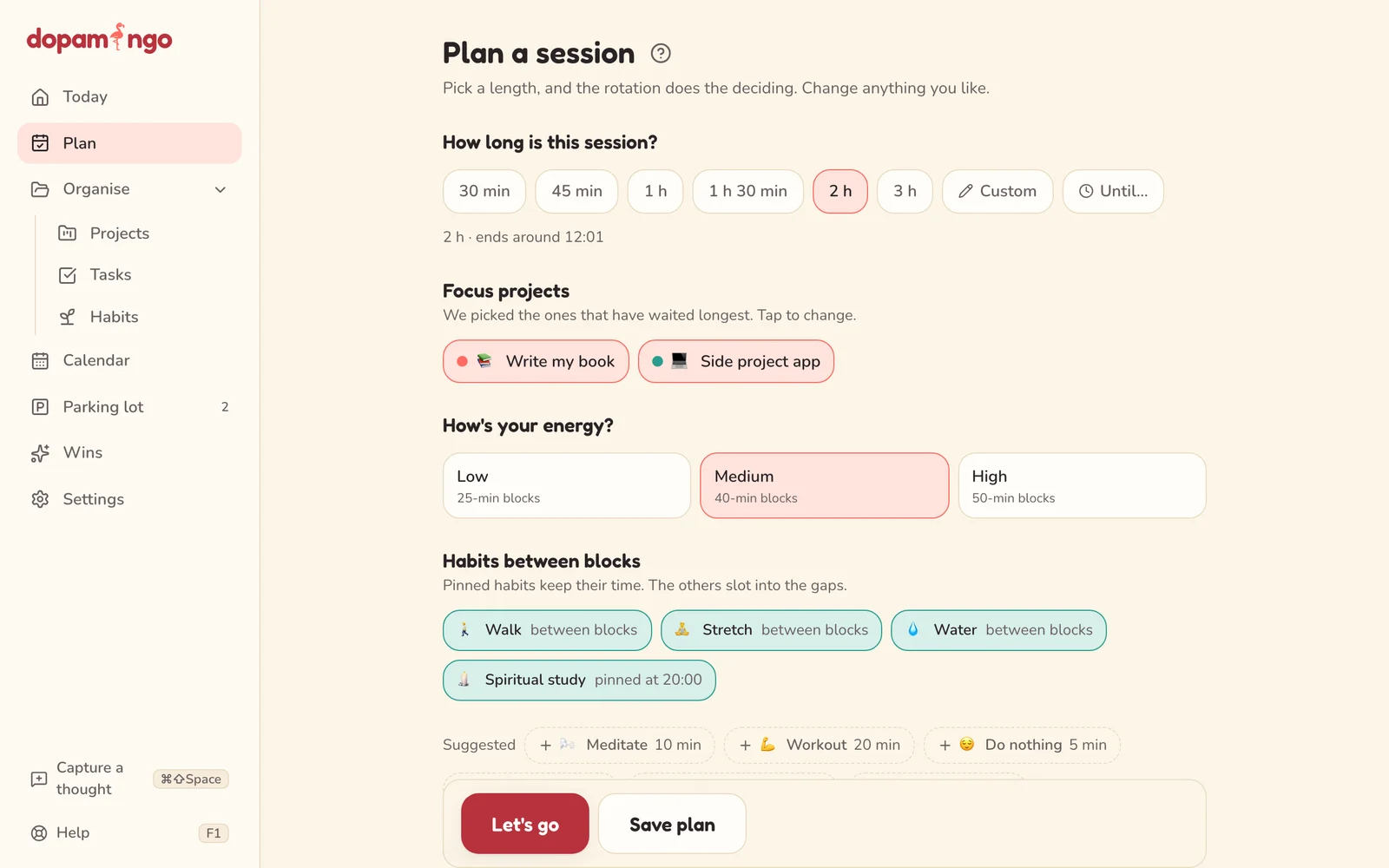
Say how long you have.
45 minutes? Until 5:30? Pick it, and Dopamingo lays out work, quick tasks and breaks to fit exactly. Today's urgent things go first. You can change anything, or just press Start.
- 2
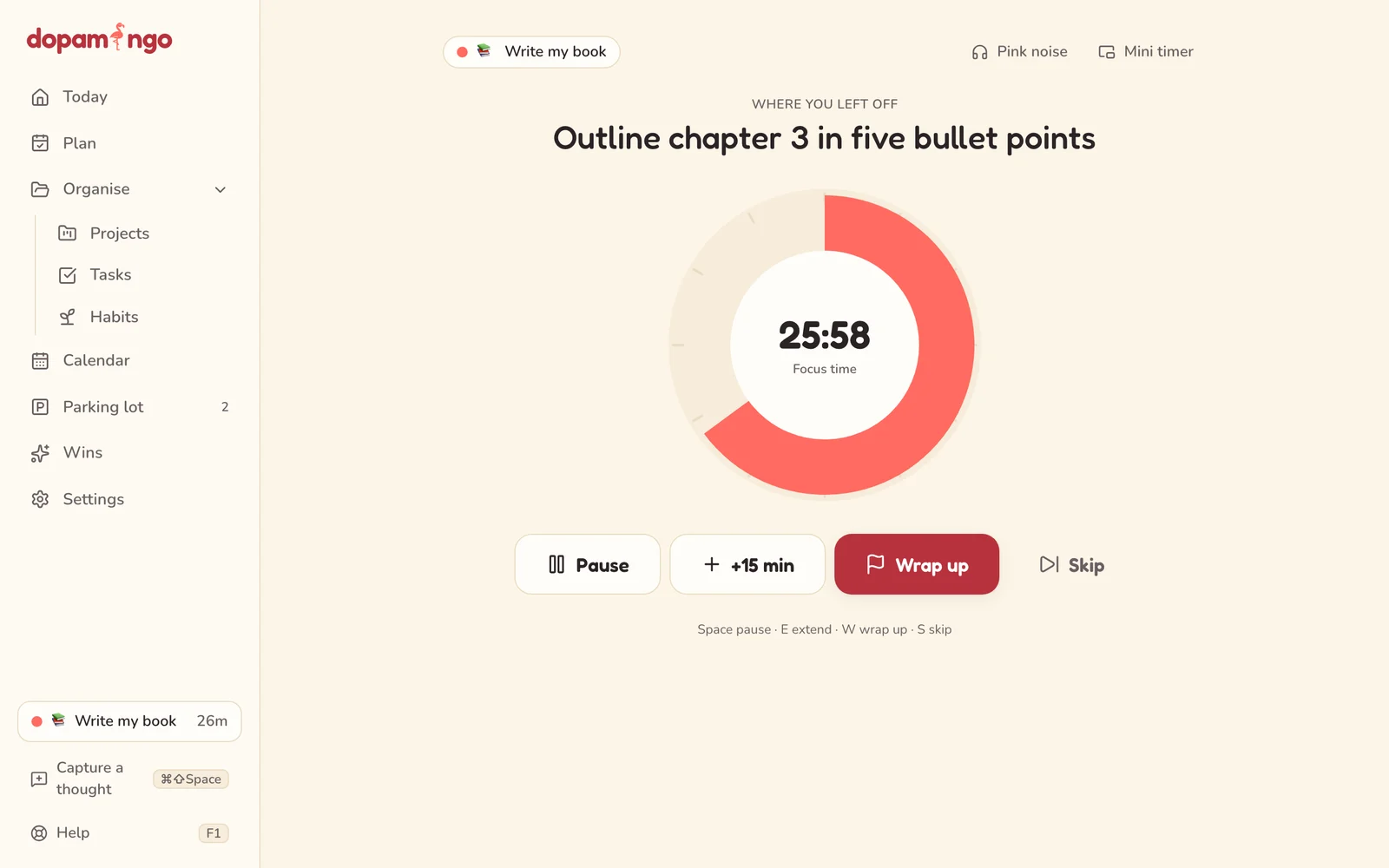
Fly.
A disc shrinks as time passes, so you can feel how much is left at a glance. The note you left last time is right there. Stray thought? One shortcut parks it, from any app, and you're back.
- 3
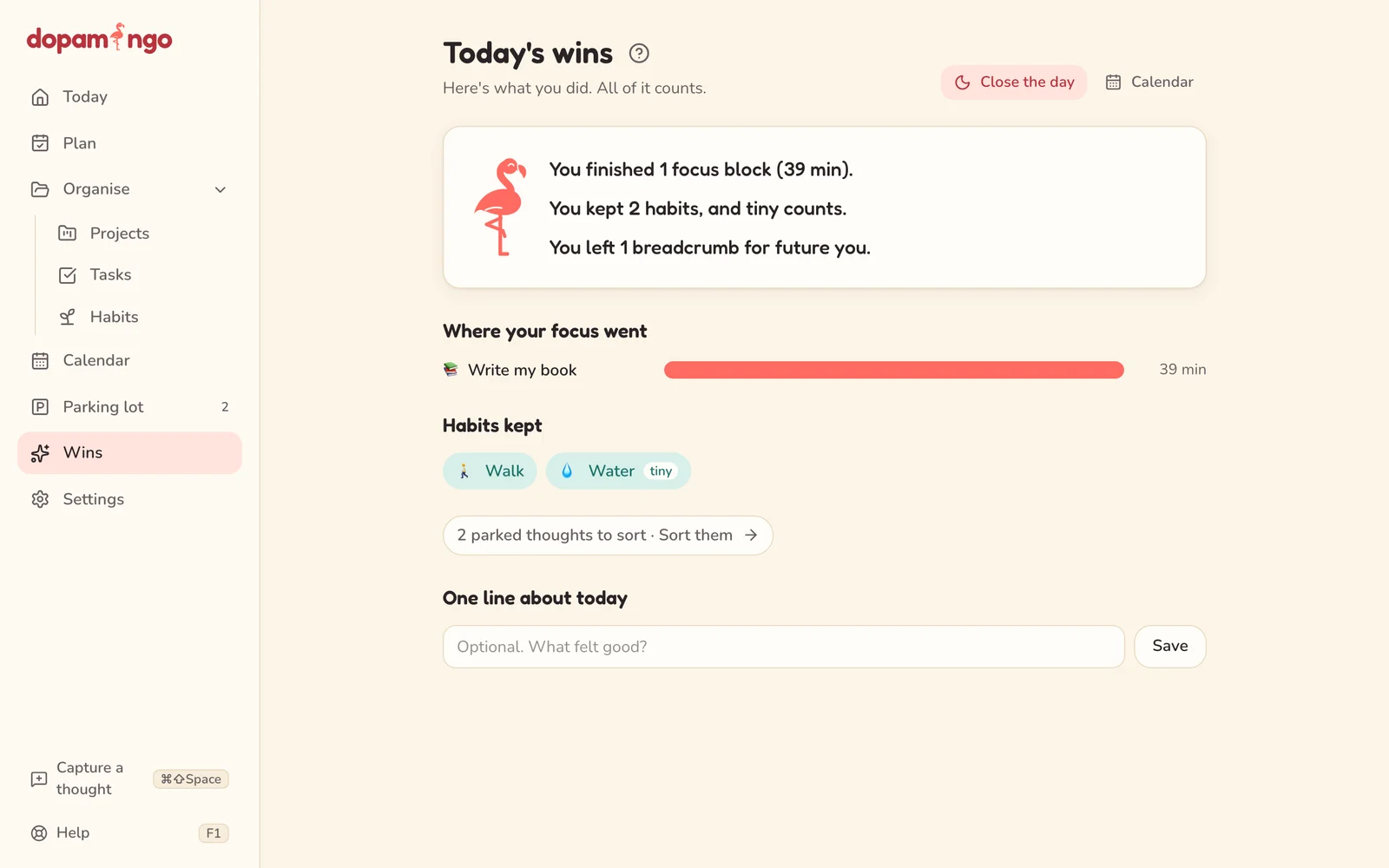
Land kindly.
When the bell rings, keep going or wrap up with a line for future you. Then a walk, a stretch or a glass of water. At the end: only your wins, and a calendar that fills up with colour.
What's inside
Every feature has a reason. Most have a study.
Time you can see, not just count.
A disc that shrinks as time passes, and the minutes left in your menu bar.
🔬 Backed by research · Marx et al. 2022Tell it how long you have. It does the rest.
Pick 45 minutes or "until 17:30" and the app lays out work, quick tasks and breaks to fit exactly.
🔬 Backed by research · Buehler, Griffin & Ross 1994Habits that start themselves.
Every habit is set up as a small plan: "After a work block, I will go for a walk."
🔬 Backed by research · Gawrilow & Gollwitzer 2008Park the thought. Keep going.
One keyboard shortcut, from any app, drops a thought into the parking lot. Sort it later.
🔬 Backed by research · Masicampo & Baumeister 2011Pick up exactly where you left off.
When a block ends you leave a line for future you, and it's the first thing you see next time.
🔬 Backed by research · Trafton, Altmann & Brock 2005Starting is the hard part. So start small.
One button starts five minutes. Then decide: keep going, or land. Both count.
🔬 Backed by research · Safren et al. 2010Hyperfocus, with a soft landing.
A heads-up two minutes before the bell, the option to keep going, and a kind nudge to stretch after 90 minutes.
🔬 Backed by research · Hupfeld, Abagis & Shah 2019Missing a day is just a day.
A two-minute "tiny version" counts as a day kept. Days kept this month, never a broken streak.
🔬 Backed by research · Lally et al. 2010A soft hum that helps some brains focus.
Optional pink or white noise that plays only while you work. Made on your computer, nothing streamed.
🔬 Backed by research · Nigg et al. 2024
Built on research, not hype
26 studies behind the design.
Time perception, if-then planning, habit formation, interruptions, rewards, movement. Each feature in Dopamingo is shaped by what researchers have found about attention and ADHD. We tell you which findings are strong and which are early, because you deserve the honest version.
Read the science →A review of 55 studies found that people with ADHD estimate and keep track of time less accurately, as if their inner clock runs at a different speed.
Marx et al. (2022), Journal of the American Academy of Child & Adolescent Psychiatry, meta-analysis
Plans written as "After X, I will Y" helped children with ADHD control impulses as well as children without ADHD in one study, and reduced switching errors in another.
Gawrilow & Gollwitzer (2008), Cognitive Therapy and Research
A meta-analysis found exercise improved executive functions such as attention and self-control in children with ADHD, and even a single bout of moderate activity helped.
Liang et al. (2021), International Journal of Behavioral Nutrition and Physical Activity, meta-analysis
Private by design
Everything stays on your computer. No account, no cloud, no tracking.
Works offline
On a train, on a plane, in a café with bad Wi-Fi.
Your data, always
Export everything any time. Even after the trial, nothing is locked away.
Calm by default
Soft colours, dark mode, reduced motion, and sounds you can turn off.
Pricing
One payment. Yours to keep.
Many ADHD apps charge you every year. Dopamingo doesn't. Try everything free first, decide later.
Dopamingo
Mac and Windows
£39
one-time
- Every feature, nothing held back
- All 1.x updates included
- Use it on up to 3 of your computers
- Works offline, no account
- 14-day free trial, no card needed
- 30-day refund, no questions asked
14-day free trial · no card, no account · Mac and Windows
Already sure? Buy now on Whop, then paste your key into the app.
Questions
Is it only for people with ADHD?
No. It's designed around ADHD research, but it works for anyone who juggles projects, gets pulled into rabbit holes or finds it hard to get started. If classic planners make you feel guilty, you'll probably like it.
Is this a medical app?
No. Dopamingo is a focus and habit tool. It isn't a medical device, and it doesn't diagnose or treat ADHD. It's built on research about attention, time and habits, and it works well alongside whatever support you already have.
Is it a subscription?
No. You pay once (£39) and it's yours, including every 1.x update. No account, no renewals to remember.
What happens after the 14-day trial?
Everything you made stays. You can still open the app, look back at your wins and calendar, and export all your data. Starting new focus sessions asks for a licence. Nothing is ever held hostage.
Which computers does it run on?
Mac (macOS 11 or later, Apple silicon and Intel) and Windows 10 or 11. One licence covers up to 3 of your own computers, Mac and Windows mixed. There's no phone app yet.
Where does my data go?
Nowhere. Everything lives on your computer. There's no account and no tracking. The app only goes online to check your licence (about once a month) and to look for updates.
Why does my Mac or PC ask me to confirm when I first open it?
Dopamingo is made by an independent developer and isn't sold through the App Store, so your computer asks you to confirm once. It takes about 20 seconds. See the steps.
What if it isn't for me?
Try it free for 14 days first. If you buy and change your mind within 30 days, email us for a full refund. No questions asked.
Your next focus block is two clicks away.
14-day free trial · no card, no account · Mac and Windows